
The idea of postplagiarism first occurred to me in 2020 I was writing my book, Plagiarism in Higher Education: Tackling Tough Topics in Academic Integrity, I began contemplating the future of plagiarism in a world where generative artificial intelligence (Gen AI) apps, and in particular, Large Language Models (LLMs) were part of our everyday lives. Remember that in 2020, GPT 2 was available, but it was not until two and half years later, in November of 2022 that Open AI released Chat GPT 3.5.
I only wrote a little about postplagiarism in the final chapter of the book. I expanded on the ideas more in a 2023 article,
Postplagiarism: transdisciplinary ethics and integrity in the age of artificial intelligence and neurotechnology.
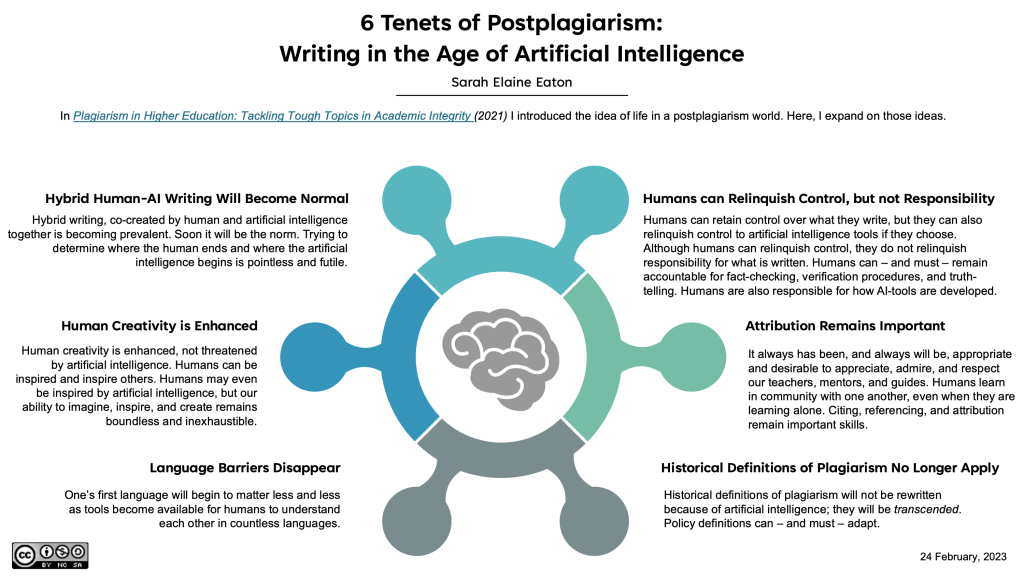
Here is the infographic that has become synonymous with postplagiarism:
Definition of Postplagiarism
Postplagiarism refers to an era in human society in which advanced technologies, including artificial intelligence and neurotechnology, including brain-computer interfaces (BCIs), are a normal part of life, including how we teach, learn, and interact daily.
Concluding Remarks
The idea of teaching, learning, and assessing student learning in the age of Generative Artificial Intelligence (GenAI) is still very much evolving. What we can say for sure is that our understanding of what is ethical conduct versus misconduct or cheating may need to evolve alongside the technology.
________
Share this post: A brief introduction to postplagiarism – https://postplagiarism.com/2024/08/21/intro/
About the author: Sarah Elaine Eaton, PhD, is a Professor in the Werklund School of Education, University of Calgary.

 Postplagiarism
Leave a reply to University Rankings Overlook Academic Retractions: A Postplagiarism Perspective – Postplagiarism Cancel reply