
Category: plagiarism
-
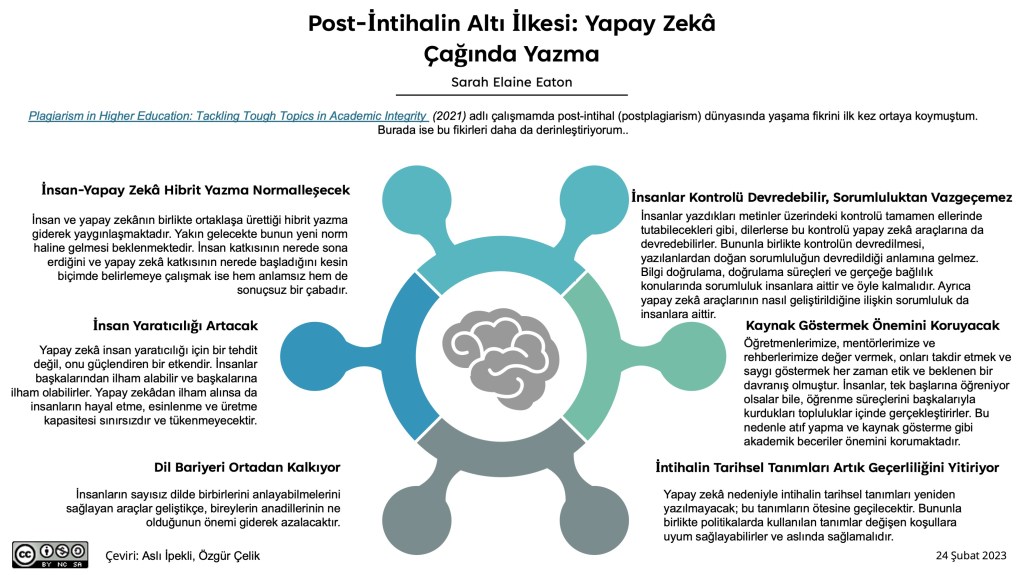
Turkish Translation of the Six Tenets of Postplagiarism
Sarah Elaine Eaton discusses the successful translation of her postplagiarism concepts into Turkish by scholars Aslı İpekli and Özgür Çelik. Their expertise in academic integrity and multilingual contexts enhances the accessibility of the six tenets, promoting dialogue among educators and students. The translated infographic is available as a free downloadable digital resource.
-

The SETA Framework: Rethinking Academic Integrity in the Postplagiarism Era
On March 4, 2026, Dr. Ruth Baker-Gardner discussed the SETA Framework for academic integrity in a world influenced by AI at the Postplagiarism Speaker Series. She emphasized that education, rather than punishment, fosters integrity and outlined support, education, teaching, and assessment as key framework elements. Institutions must adapt policies to ensure effective learning and ethical…
-

Postplagiarism Perspectives: Comparative Insights from K-12 and Postsecondary Research
The integration of Generative AI in education creates a significant shift in teaching and assessment methods. Research highlights challenges in K–12 and professional education regarding ethical AI use and institutional policies. Bridging the gap between traditional curricula and evolving competencies is crucial for fostering accountability and integrity in AI engagement among students and educators.
-

Translating Knowledge for Global Impact: How Jacque Bampi Brought Postplagiarism Principles to Portuguese
The translation of the infographic “6 Principles of Post-Plagiarism: The Art of Writing in the Age of Artificial Intelligence” into Portuguese by Jacque Bampi promotes academic integrity and innovation in a digital landscape. It addresses key principles of writing and ethics, ensuring accessibility for Portuguese-speaking educators and fostering inclusive discussions on these vital topics.
-

Postplagiarism Fundamentals: Integrity and Ethics in the Age of GenAI
Dr. Sarah Elaine Eaton’s presentation on postplagiarism introduces a framework for understanding integrity and ethics amidst generative AI advancements. She outlines six tenets highlighting the importance of responsibility in writing, the role of attribution, and shifts in educational practices. The concept promotes teaching over policing in academic integrity, gaining global recognition.
-

A Brief History of Postplagiarism: Or, Why Fabrication is Not the New Flattery
In this post I share how I discovered a peer-reviewed article on postplagiarism that includes fake references, including attributed work that I never wrote. I summarize legitimate contributions to the postplagiarism discourse, emphasizing the importance of responsibility in written work, and highlight our website offering free resources.
-

2025-2026 Postplagiarism Speaker Series: Navigating AI in Education
The 2025-2026 Postplagiarism Speaker Series, hosted by CAIELI at the University of Calgary, explores AI’s impact on education and academic integrity. It features leading researchers discussing practical strategies for integrating AI while preserving ethical standards. The series aims to reshape assessments and cultivate integrity in AI-enhanced learning environments.
-

New open access chapter: Corruption in the post-plagiarism era: weaponizing reputation and morality in the name of integrity in higher education
Sarah Elaine Eaton reflects on her admiration for Philip Altbach, Hans de Wit, and Elena Denisova-Schmidt, culminating in her contribution to the newly published “Handbook on Corruption in Higher Education.” Eaton’s chapter discusses corruption in the post-plagiarism era, exploring the manipulation of reputation and morality in higher education, emphasizing integrity.
-

New Open Access Chapter: “Pedagogical Ethics: Navigating Learning in a Generative AI-Augmented Environment in a Post-Plagiarism Era”
The chapter “Pedagogical Ethics: Navigating Learning in a Generative AI-Augmented Environment in a Post-Plagiarism Era,” co-authored by Sarah Elaine Eaton and Mohammad Keyhani, discusses the implications of generative AI in education, focusing on academic integrity and pedagogical ethics. It emphasizes learner agency and offers guidance for educators, available as open access.
-

Postplagiarism: Understanding the Difference Between Referencing and Giving Attribution
In the talks I give on postplagiarism, I distinguish between attribution and referencing amid evolving academic practices influenced by artificial intelligence. Attribution transcends mere technical referencing. The discourse urges an exploration of attribution as an ethical commitment in the postplagiarism era.
 Postplagiarism