
Author: Sarah Elaine Eaton, Ph.D.
-
ChatGPT is in classrooms. What now?
“What should we be assessing exactly?” This was a question one of our research participants asked when we interviewed them as part of our project on artificial intelligence and academic integrity, sponsored by a University of Calgary Teaching Grant. In an article published in The Conversation, we provide highlights of the results from our interviews…
-
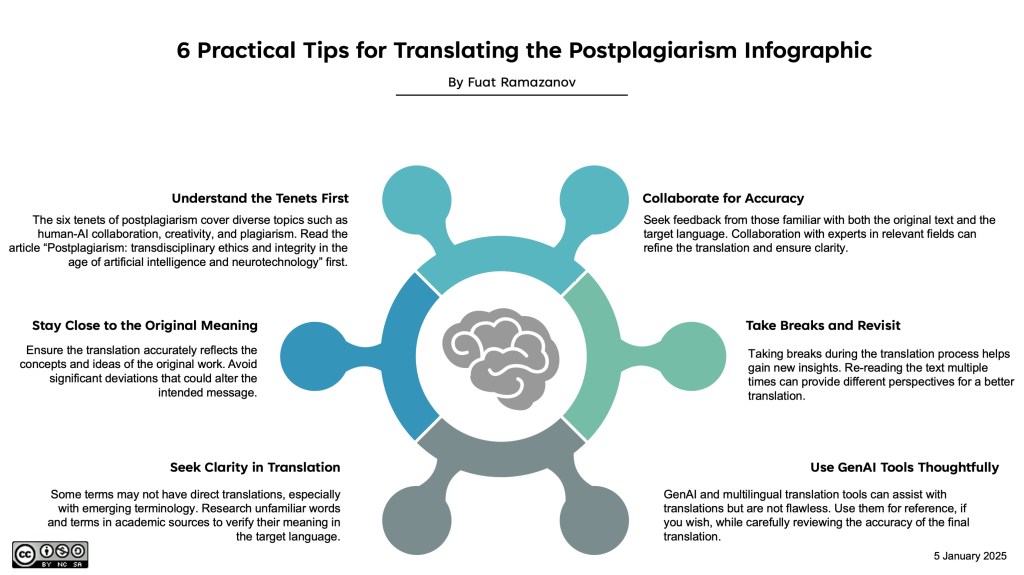
Six Practical Tips for Translating the Postplagiarism Infographic
In this post, Fuat Ramazanov offers his tips for translating the postplagiarism infographic. by Fuat Ramazanov I recently worked on translating an infographic titled “6 Tenets of Postplagiarism: Writing in the Age of Artificial Intelligence”, created by Dr. Sarah Elaine Eaton. Because I do not often translate academic work, I chose to document my approach…
-

Translating Knowledge for Global Impact: How Jacque Bampi Brought Postplagiarism Principles to Portuguese
The translation of the infographic “6 Principles of Post-Plagiarism: The Art of Writing in the Age of Artificial Intelligence” into Portuguese by Jacque Bampi promotes academic integrity and innovation in a digital landscape. It addresses key principles of writing and ethics, ensuring accessibility for Portuguese-speaking educators and fostering inclusive discussions on these vital topics.
-

What Should We Be Assessing in a World with AI? Insights from Higher Education Educators
The emergence of generative AI, such as ChatGPT, challenges assessment practices in higher education. A study of 28 Canadian educators found a consensus on assessing prompting and critical thinking skills while raising concerns about writing assessments. Emphasizing ethical AI integration, educators highlight the need for ongoing discussions on maintaining academic integrity in technology-driven environments.
-

Postplagiarism Fundamentals: Integrity and Ethics in the Age of GenAI
Dr. Sarah Elaine Eaton’s presentation on postplagiarism introduces a framework for understanding integrity and ethics amidst generative AI advancements. She outlines six tenets highlighting the importance of responsibility in writing, the role of attribution, and shifts in educational practices. The concept promotes teaching over policing in academic integrity, gaining global recognition.
-

A Brief History of Postplagiarism: Or, Why Fabrication is Not the New Flattery
In this post I share how I discovered a peer-reviewed article on postplagiarism that includes fake references, including attributed work that I never wrote. I summarize legitimate contributions to the postplagiarism discourse, emphasizing the importance of responsibility in written work, and highlight our website offering free resources.
-

Decriminalizing Academic Integrity Language
Sarah Elaine Eaton discusses the concept of decriminalizing language related to academic misconduct, emphasizing a supportive, educational approach rather than a punitive one.This shift encourages dignity and ethical decision-making in academia.
-
2025-2026 Postplagiarism Speaker Series: Navigating AI in Education
The 2025-2026 Postplagiarism Speaker Series, hosted by CAIELI at the University of Calgary, explores AI’s impact on education and academic integrity. It features leading researchers discussing practical strategies for integrating AI while preserving ethical standards. The series aims to reshape assessments and cultivate integrity in AI-enhanced learning environments.
-

New open access chapter: Corruption in the post-plagiarism era: weaponizing reputation and morality in the name of integrity in higher education
Sarah Elaine Eaton reflects on her admiration for Philip Altbach, Hans de Wit, and Elena Denisova-Schmidt, culminating in her contribution to the newly published “Handbook on Corruption in Higher Education.” Eaton’s chapter discusses corruption in the post-plagiarism era, exploring the manipulation of reputation and morality in higher education, emphasizing integrity.
-

New Open Access Chapter: “Pedagogical Ethics: Navigating Learning in a Generative AI-Augmented Environment in a Post-Plagiarism Era”
The chapter “Pedagogical Ethics: Navigating Learning in a Generative AI-Augmented Environment in a Post-Plagiarism Era,” co-authored by Sarah Elaine Eaton and Mohammad Keyhani, discusses the implications of generative AI in education, focusing on academic integrity and pedagogical ethics. It emphasizes learner agency and offers guidance for educators, available as open access.
 Postplagiarism