
Language is one of the most important ways people connect with one another. It allows us to share ideas, express emotions, build relationships, and understand the world around us. But language can also create barriers, especially when people need to communicate across different languages.
One of the six tenets of postplagiarism is “Language barriers disappear.” Eaton (2023) explains that this tenet does not mean that first languages will become unimportant. Rather, the idea is that as technologies for translation become more available and effective, people may increasingly be able to understand one another across many languages. Eaton specifically describes this as an increase in our ability to transcend language barriers, while recognizing that language also involves culture, politics, identity, and interpretation.
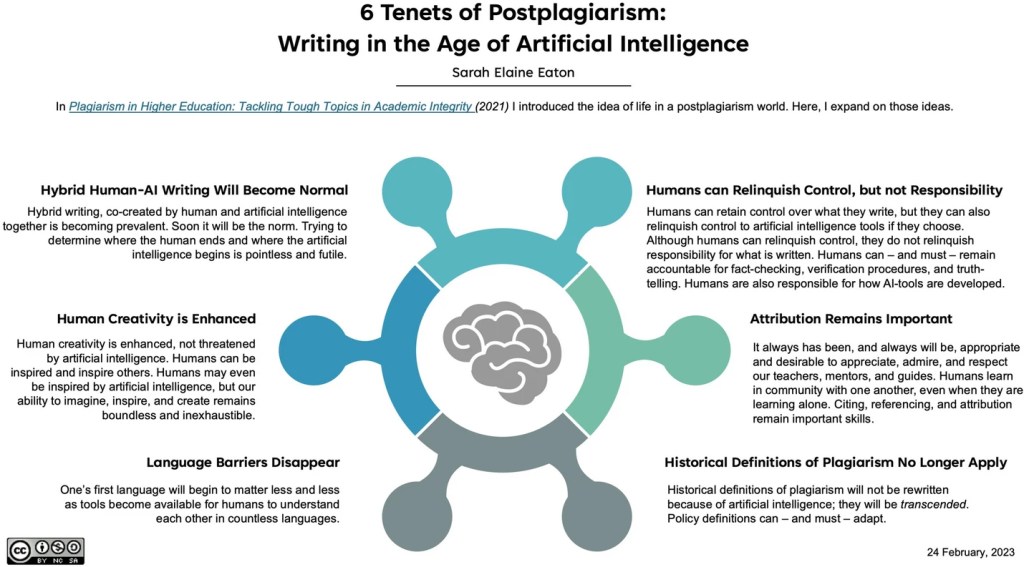
Six tenets of postplagiarism
New evidence from healthcare offers an interesting example of how the third postplagiarism tenet is developing.
Anisman et al. (2026) examined wearable translation devices in a medical setting. The researchers created simulated medical appointments involving English-speaking healthcare providers and Spanish- and Mandarin-speaking patients. They tested widely available wearable devices that include real-time live translation features. Instead of requiring a speaker to stop while a translation is provided, the technology allows the wearer to hear a near real-time translation of what the other person is saying.
The researchers evaluated the translations sentence by sentence using four categories: fluency (flow of speech), adequacy (completeness and contextual appropriateness), meaning (translation fidelity), and severity (likely clinical impact of any error).
The results show both progress and limitations.
The wearable translation performed strongly overall. In Spanish, the better-performing device received average scores of 4.94 for fluency, 4.86 for adequacy, 4.82 for meaning, and 4.91 for severity on a five-point scale. However, performance was lower when translating Mandarin. The study also found that the devices made clinically significant errors, including two in Spanish and nine in Mandarin for the device tested in both languages.
Some errors were particularly important. The devices sometimes misunderstood individual words or struggled with expressions that depended on context. In one serious example, the device failed to hear the word “not,” which reversed an instruction. At the same time, the technology handled many medical terms accurately, including terms such as ““Tylenol,” “nasal polyps,” “cauterize,” and “endoscopy.”
There was also a practical benefit. Compared with visits using an in-person translator, live translation reduced the length of medical visits by 14% to 32% in this study. This finding is important because language barriers can sometimes make healthcare less accessible when professional interpreters are unavailable or add time to a visit.
This evidence gives us a more concrete way to understand Eaton’s third tenet. Wearable translation does not make different languages disappear. Instead, it can make communication between people who speak different languages more possible in situations where language would previously have created a significant barrier.
At the same time, the study shows why translation cannot simply be treated as a technical problem that has been solved. A fluent-sounding translation can still contain an important error. In healthcare, a small mistake can have serious consequences. The researchers therefore recommend further collaboration among technology companies, physicians, and medical translators to improve terminology, privacy, and contextual accuracy. They also caution against rushing to introduce these technologies simply because they may save time or money.
The findings also reflect a broader development in wearable technology. Eaton et al. (2026) identify real-time translation as one of the emerging capabilities of AI wearables and argue that these technologies can provide new forms of accessibility and support. At the same time, they emphasize the need to understand both the benefits and limitations of wearable technologies rather than treating them simply as technological solutions.
The study by Anisman et al. (2026) provides new evidence that technologies are making it increasingly possible to communicate across languages in real time. That is closely aligned with what Eaton (2023) intended when introducing the tenet: the availability and effectiveness of technologies that help people transcend language barriers are likely to increase. The future of communication may therefore involve fewer situations in which speaking a different first language prevents people from understanding one another. But technology alone cannot guarantee understanding. Language carries meaning, context, culture, and responsibility. The challenge of the postplagiarism era will be to use new forms of translation while continuing to recognize the human knowledge and judgment needed to communicate accurately.
References
Anisman, E. J., Pudik, N., Palacio‐Morales, L., Alani, A., Qu, Y., Liu, C., Arce, A., Chan, S. H. T., Bitner, B., Rosen, M., Nyquist, G., Toskala, E., & Rabinowitz, M. (2026). Wearable Real‐Time Translation in Rhinology: A Comparative Study of Accuracy and Efficiency. International Forum of Allergy & Rhinology, 16(7), 743–745. https://doi.org/10.1002/alr.70193
Eaton, S. E. (2023). Postplagiarism: transdisciplinary ethics and integrity in the age of artificial intelligence and neurotechnology. International Journal for Educational Integrity, 19(1). https://doi.org/10.1007/s40979-023-00144-1
Eaton, S. E., Kumar, R., Dahal, B., Tang, G., Ramazanov, F., & Moya Figueroa, B. A. (2026). AI smart glasses and the future of academic integrity in a postplagiarism era. Canadian Perspectives on Academic Integrity, 9(1), 1–5. https://doi.org/10.55016/ojs/cpai.v9i1/82885


Leave a comment