
by Sarah Elaine Eaton
The Postplagiarism Research Lab is pleased to announce the release of the Georgian translation of the Six Tenets of Postplagiarism infographic. This resource represents a significant step in making the framework accessible to educators and researchers in Georgia and beyond. Postplagiarism refers to a period in human history where artificial intelligence becomes an integral part of daily life, influencing how individuals teach, learn, and interact.
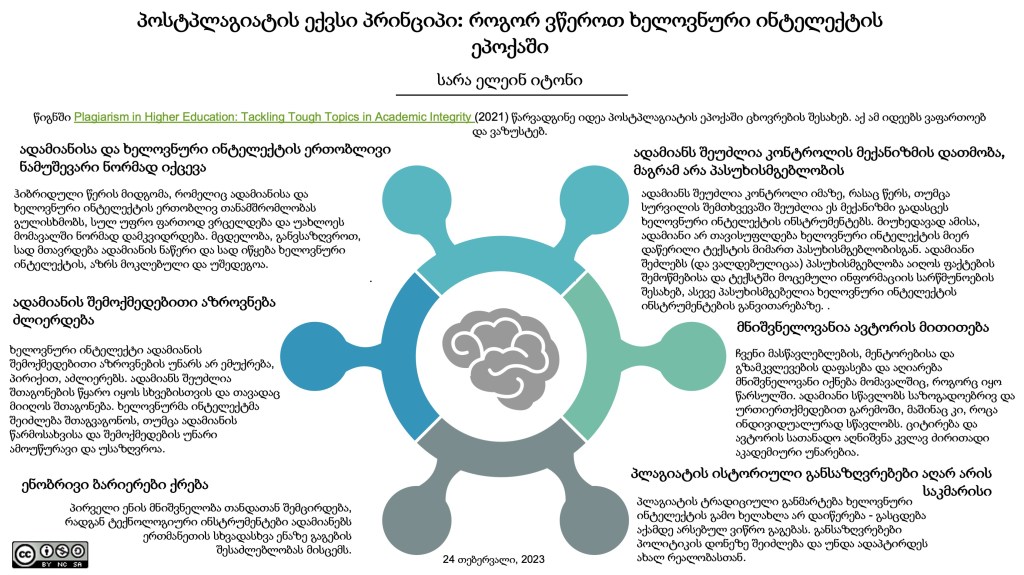
The six tenets of postplagiarism provide a framework for understanding writing in the age of artificial intelligence:
- Hybrid Human-AI Writing Will Become Normal: The co-creation of text by humans and artificial intelligence is becoming prevalent and will soon be the standard. Determining the exact boundary between human and machine contributions is a futile task.
- Human Creativity is Enhanced: Artificial intelligence does not threaten human creativity but rather strengthens it. While machines can provide inspiration, the human capacity for imagination and creation remains boundless.
- Language Barriers Disappear: As technological tools enable people to understand each other across numerous languages, the significance of a person’s first language will decrease.
- Humans can Relinquish Control, but not Responsibility: Authors may choose to let artificial intelligence tools handle aspects of writing, but they remain accountable for the final output. This includes responsibility for fact-checking and ensuring the accuracy of information.
- Attribution Remains Important: Respecting and acknowledging the contributions of teachers and mentors is a fundamental aspect of learning in a community. Skills related to citing and referencing remain essential.
- Historical Definitions of Plagiarism No Longer Apply: Existing definitions of plagiarism are being transcended rather than rewritten. Institutional policies must adapt to this new reality.
The translation was completed by Giga Khositashvili, PhD, an Assistant Professor and a Director of the Center for Distance Education and Academic Integrity at Ilia State University in Georgia. Dr. Khositashvili is an expert in academic integrity and educational technology. His doctoral research focused on the culture of academic integrity in Georgian higher education institutions, specifically examining plagiarism perception among staff and the adaptation of text-matching software.
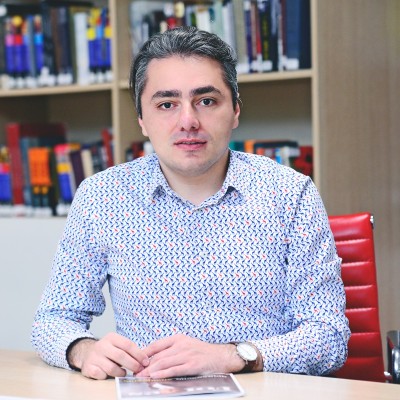
Dr. Khositashvili has a distinguished record of service in the field. He received the Turnitin Global Innovation Award in 2019 for his work in Europe. His professional background includes seven years as the Deputy Library Director at Ilia State University, where he managed initiatives related to e-learning and academic resource management. He has also contributed to international projects such as the Erasmus+ CBHE INTEGRITY project, which involved training over 340 staff members, and currently another CBHE initiative on research ethics and integrity – ETHICS project.
The availability of this translation supports the global dialogue on ethics and integrity in the era of generative artificial intelligence. The Postplagiarism Research Lab continues to seek collaborations that expand the reach of these principles to diverse linguistic and cultural contexts.
______________
Share this post: Georgian translation of the six tenets of postplagiarism now available – https://postplagiarism.com/2026/04/06/georgian-translation-of-the-six-tenets-of-postplagiarism-now-available/
 Postplagiarism
Leave a comment