
We are thrilled to announce a new milestone for the Postplagiarism Research Lab: the translation of the Postplagiarism infographic into Nepali.
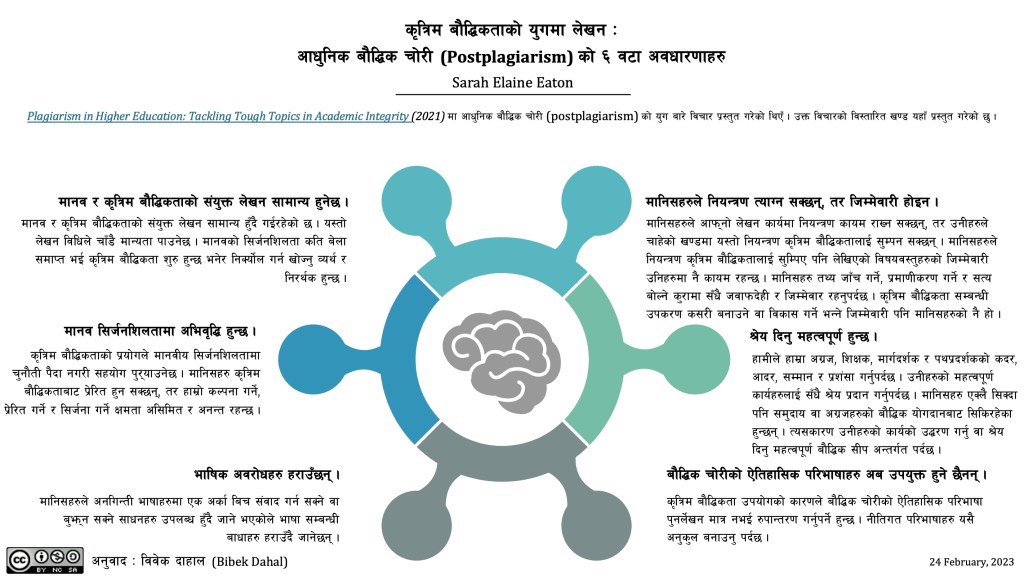
This initiative continues our mission to democratize the conversation around AI ethics and academic integrity, ensuring that language is not a barrier to understanding the evolving landscape of higher education.
Why Nepali?
The decision to prioritize a Nepali translation was driven by research into the policy landscape of the region (Dahal & Eaton, 2025). This work was spearheaded by Mr. Bibek Dahal, whose insights highlight the critical need for localized resources.
As Mr. Dahal notes:
“Our analysis of academic and research integrity policies in Nepali universities (Dahal & Eaton, 2025) identified the majority of relevant policy documents were written in Nepali. It shows that Nepali is an official language in education sector in Nepal. Any academic integrity related materials translated into Nepali would be more beneficial for students, teachers, and policymakers who feel comfortable in teaching, learning, designing assessment, and developing policies in Nepali language.”
A Lens for the Future of Education
The Postplagiarism framework (Eaton, 2023) was designed to move beyond traditional ‘detect and punish’ models, focusing instead on how we coexist with generative AI and neurotechnology. By bringing these six tenets to Nepali-speaking communities, we hope to foster more inclusive and nuanced discussions about what it means to be an author in the 21st century.
Reflecting on the impact of this translation, Mr. Dahal shares:
“Eaton’s (2023) six tenets of Postplagiarism is a lens to understand the ethical integration of artificial intelligence, including neurotechnology into education and human society. Its translation into Nepali language would help interested parties including students in Nepali school and higher education to understand how the use of artificial intelligence is changing the way we understand writing, human creativity, language difficulties, academically honest behaviours, and academic integrity.”
Access the Resource
The Nepali version of the infographic is now available for download on our Resources Page. We encourage educators, students, and administrators in Nepal and the diaspora to use, share, and discuss these materials as they navigate the complexities of AI in their own contexts.
We extend our deepest gratitude to Bibek Dahal for his expertise and dedication to this project.
Share this post: Expanding Global Conversations: Postplagiarism Framework Translated into Nepali – https://postplagiarism.com/2026/02/09/expanding-global-conversations-postplagiarism-framework-translated-into-nepali/
 Postplagiarism
Leave a comment