
Tag: plagiarism
-

Decriminalizing Academic Integrity Language
Sarah Elaine Eaton discusses the concept of decriminalizing language related to academic misconduct, emphasizing a supportive, educational approach rather than a punitive one.This shift encourages dignity and ethical decision-making in academia.
-
2025-2026 Postplagiarism Speaker Series: Navigating AI in Education
The 2025-2026 Postplagiarism Speaker Series, hosted by CAIELI at the University of Calgary, explores AI’s impact on education and academic integrity. It features leading researchers discussing practical strategies for integrating AI while preserving ethical standards. The series aims to reshape assessments and cultivate integrity in AI-enhanced learning environments.
-

New open access chapter: Corruption in the post-plagiarism era: weaponizing reputation and morality in the name of integrity in higher education
Sarah Elaine Eaton reflects on her admiration for Philip Altbach, Hans de Wit, and Elena Denisova-Schmidt, culminating in her contribution to the newly published “Handbook on Corruption in Higher Education.” Eaton’s chapter discusses corruption in the post-plagiarism era, exploring the manipulation of reputation and morality in higher education, emphasizing integrity.
-

New Open Access Chapter: “Pedagogical Ethics: Navigating Learning in a Generative AI-Augmented Environment in a Post-Plagiarism Era”
The chapter “Pedagogical Ethics: Navigating Learning in a Generative AI-Augmented Environment in a Post-Plagiarism Era,” co-authored by Sarah Elaine Eaton and Mohammad Keyhani, discusses the implications of generative AI in education, focusing on academic integrity and pedagogical ethics. It emphasizes learner agency and offers guidance for educators, available as open access.
-

Postplagiarism: Understanding the Difference Between Referencing and Giving Attribution
In the talks I give on postplagiarism, I distinguish between attribution and referencing amid evolving academic practices influenced by artificial intelligence. Attribution transcends mere technical referencing. The discourse urges an exploration of attribution as an ethical commitment in the postplagiarism era.
-
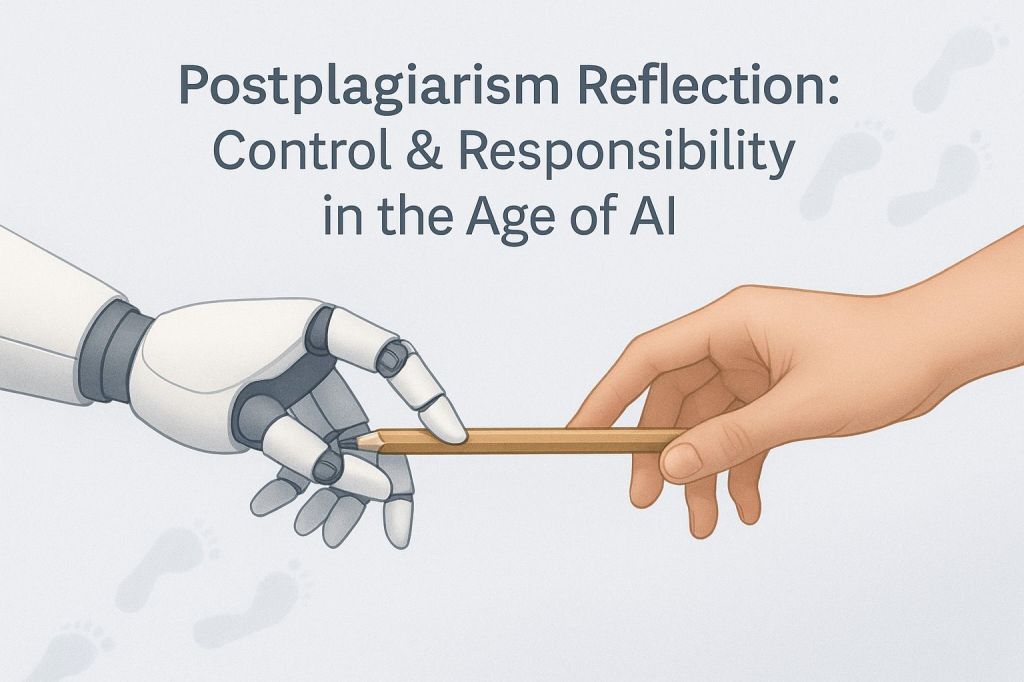
Postplagiarism Reflection: On Control & Responsibility
In our digital age of remixing, re-using, sharing, and collaborative creation, we’re challenged to rethink ownership. Postplagiarism invites us to embrace a profound paradox: We can relinquish control (in part or in whole) to an AI app to either generate work on our behalf or provide a starting point that we then build upon. But,…
-
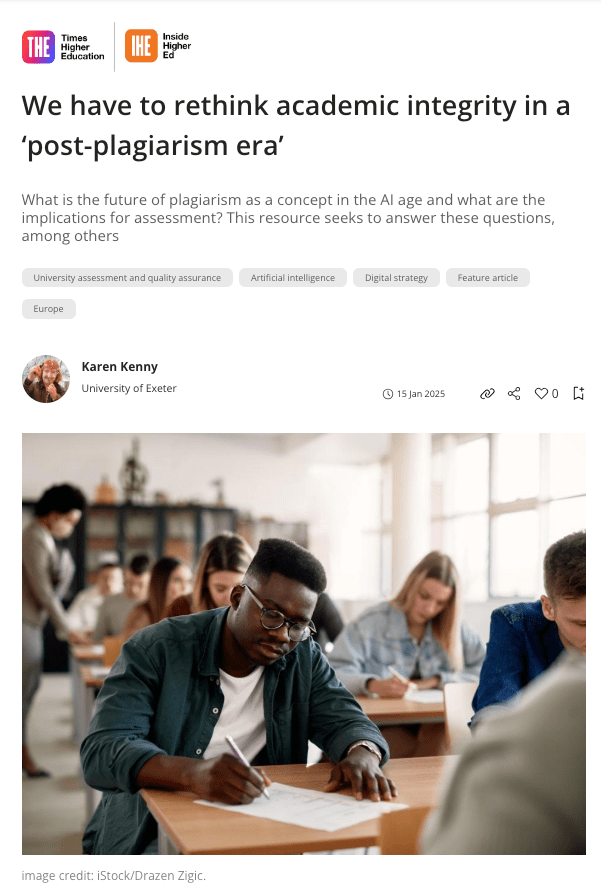
Postplagiarism in Times Higher Education
Karen Kenny discusses the concept of Postplagiarism in an article for Times Higher Education. The piece highlights evolving perspectives on academic integrity and originality in scholarly work. This is the first time postplagiarism has been mentioned in THE.
-

Plagiarism (Re)Defined: Why Attribution Matters More Than Ever in a Postplagiarism World
The concept of plagiarism lacks a universal definition, being culturally and contextually influenced. It encompasses various types of work, including text, ideas, and designs. With a postplagiarism focus, we shift from punishment to fostering proper attribution practices, especially in light of AI’s impact on creativity. Institutions must clearly define and educate about plagiarism policies.
-

Upcoming Talk: From Plagiarism to Postplagiarism: Navigating the GenAI Revolution in Higher Education
Join us on January 29, 2025, for the inaugural postplagiarism talk titled “From Plagiarism to Postplagiarism: Navigating the GenAI Revolution in Higher Education,” led by Dr. Sarah Elaine Eaton. This hybrid event will address integrating Generative AI in academia while maintaining integrity and fostering original scholarship. Register to participate!
-

Understanding Postplagiarism: Ethics in the Digital Age
Postplagiarism is defined as a new era where advanced technologies, such as AI and brain-computer interfaces, change intellectual engagement. It emphasizes the importance of attribution and accountability, contrary to absolute relativism or merely relying on technology. Critical thinking and digital literacy are crucial in teaching ethical interactions with these tools.
 Postplagiarism