
Category: Responsibility
-

Translating Knowledge for Global Impact: How Jacque Bampi Brought Postplagiarism Principles to Portuguese
The translation of the infographic “6 Principles of Post-Plagiarism: The Art of Writing in the Age of Artificial Intelligence” into Portuguese by Jacque Bampi promotes academic integrity and innovation in a digital landscape. It addresses key principles of writing and ethics, ensuring accessibility for Portuguese-speaking educators and fostering inclusive discussions on these vital topics.
-

Our Epistemic Boundaries between Learning and Assessment in a Postplagiarism Era
Bibek Dahal reflects on the postplagiarism speaker series led by Dr. Soroush Sabbaghan at the University of Calgary, focusing on the challenges of adapting learning and assessment practices in the era of generative AI. Key themes include the need for visible learning processes and prioritizing integrity, belonging, and human judgment over mere artifact-based assessments.
-

Postplagiarism Fundamentals: Integrity and Ethics in the Age of GenAI
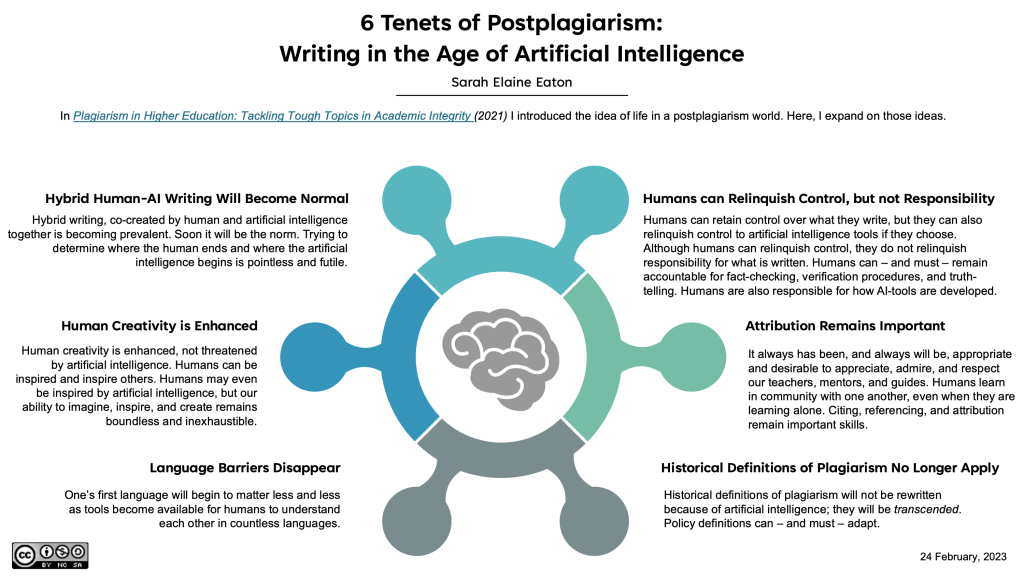
Dr. Sarah Elaine Eaton’s presentation on postplagiarism introduces a framework for understanding integrity and ethics amidst generative AI advancements. She outlines six tenets highlighting the importance of responsibility in writing, the role of attribution, and shifts in educational practices. The concept promotes teaching over policing in academic integrity, gaining global recognition.
-
2025-2026 Postplagiarism Speaker Series: Navigating AI in Education
The 2025-2026 Postplagiarism Speaker Series, hosted by CAIELI at the University of Calgary, explores AI’s impact on education and academic integrity. It features leading researchers discussing practical strategies for integrating AI while preserving ethical standards. The series aims to reshape assessments and cultivate integrity in AI-enhanced learning environments.
-

New Open Access Chapter: “Pedagogical Ethics: Navigating Learning in a Generative AI-Augmented Environment in a Post-Plagiarism Era”
The chapter “Pedagogical Ethics: Navigating Learning in a Generative AI-Augmented Environment in a Post-Plagiarism Era,” co-authored by Sarah Elaine Eaton and Mohammad Keyhani, discusses the implications of generative AI in education, focusing on academic integrity and pedagogical ethics. It emphasizes learner agency and offers guidance for educators, available as open access.
-
Postplagiarism Reflection: On Control & Responsibility
In our digital age of remixing, re-using, sharing, and collaborative creation, we’re challenged to rethink ownership. Postplagiarism invites us to embrace a profound paradox: We can relinquish control (in part or in whole) to an AI app to either generate work on our behalf or provide a starting point that we then build upon. But,…
-

Understanding Postplagiarism: Ethics in the Digital Age
Postplagiarism is defined as a new era where advanced technologies, such as AI and brain-computer interfaces, change intellectual engagement. It emphasizes the importance of attribution and accountability, contrary to absolute relativism or merely relying on technology. Critical thinking and digital literacy are crucial in teaching ethical interactions with these tools.
-

University Rankings Overlook Academic Retractions: A Postplagiarism Perspective
University rankings often emphasize metrics like publication counts but fail to consider critical issues like academic retractions due to misconduct. Recent studies highlight the impact of retractions on research quality and integrity, suggesting that ranking systems need to incorporate these factors to reflect authentic academic reputation accurately and ensure fairness among institutions.
-

Redefining Plagiarism in the Age of AI
The online presentation “Redefining Plagiarism” discussed the evolving concept of plagiarism in light of technological advancements, particularly Generative AI. As AI blurs the lines of originality and intellectual ownership, definitions of plagiarism must adapt. It emphasizes the need for quality-focused evaluation and maintains the importance of human accountability in creative work.
-
 Postplagiarism