
Category: Postplagiairism
-

When Good Ideas Meet Poor Execution: The Humane AI Pin and the Future of Language Translation
The Humane AI Pin aimed to revolutionize language translation through wearable technology powered by AI. Despite initial hype and strong pre-orders, user reviews were poor due to execution issues, leading to its retirement within a year. Nonetheless, the failure highlights the potential for AI to break language barriers in integrated applications.
-
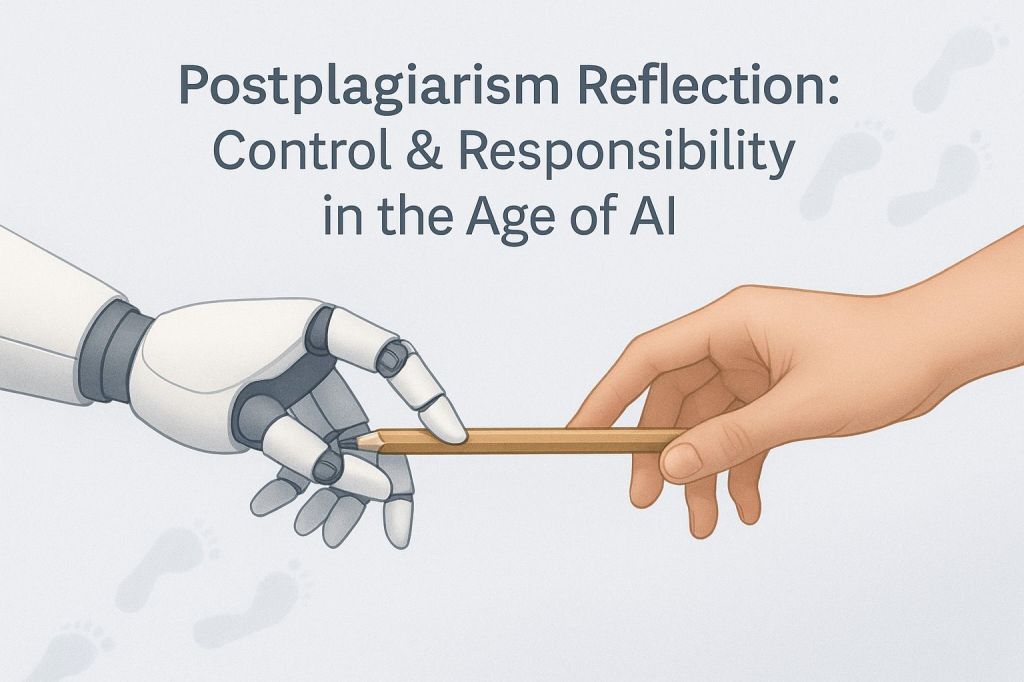
Postplagiarism Reflection: On Control & Responsibility
In our digital age of remixing, re-using, sharing, and collaborative creation, we’re challenged to rethink ownership. Postplagiarism invites us to embrace a profound paradox: We can relinquish control (in part or in whole) to an AI app to either generate work on our behalf or provide a starting point that we then build upon. But,…
-

Teaching Fact-Checking Through Deliberate Errors: An Essential AI Literacy Skill
This teaching resource presents a method for enhancing AI literacy by engaging students in fact-checking AI-generated content with intentional inaccuracies. It emphasizes systematic verification processes, critical evaluation of sources, and understanding AI error patterns, equipping students with essential skills to discern accurate information in a postplagiarism landscape.
-

Embracing AI as a Teaching Tool: Practical Approaches for the Postplagiarism Classroom
Artificial intelligence (AI) can be a useful educational tool in the postplagiarism classroom. Effective strategies include incorporating AI into discussions, enhancing critical thinking, teaching fact-checking, and addressing ethical considerations. This shift fosters student engagement with technology, emphasizing evaluation over mere content creation and preparing them for future challenges.
-
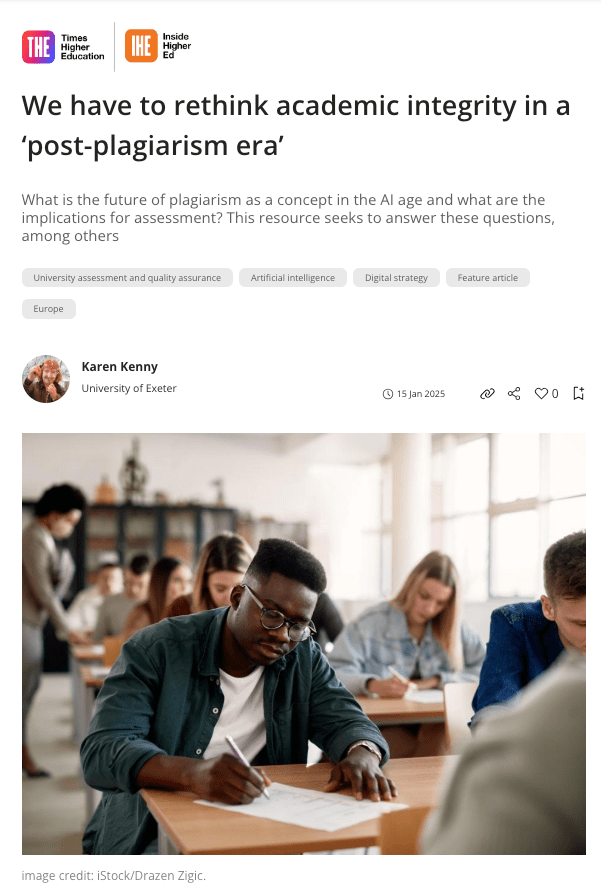
Postplagiarism in Times Higher Education
Karen Kenny discusses the concept of Postplagiarism in an article for Times Higher Education. The piece highlights evolving perspectives on academic integrity and originality in scholarly work. This is the first time postplagiarism has been mentioned in THE.
-

Plagiarism (Re)Defined: Why Attribution Matters More Than Ever in a Postplagiarism World
The concept of plagiarism lacks a universal definition, being culturally and contextually influenced. It encompasses various types of work, including text, ideas, and designs. With a postplagiarism focus, we shift from punishment to fostering proper attribution practices, especially in light of AI’s impact on creativity. Institutions must clearly define and educate about plagiarism policies.
-

Upcoming Talk: From Plagiarism to Postplagiarism: Navigating the GenAI Revolution in Higher Education
Join us on January 29, 2025, for the inaugural postplagiarism talk titled “From Plagiarism to Postplagiarism: Navigating the GenAI Revolution in Higher Education,” led by Dr. Sarah Elaine Eaton. This hybrid event will address integrating Generative AI in academia while maintaining integrity and fostering original scholarship. Register to participate!
-
Understanding Postplagiarism: Ethics in the Digital Age
Postplagiarism is defined as a new era where advanced technologies, such as AI and brain-computer interfaces, change intellectual engagement. It emphasizes the importance of attribution and accountability, contrary to absolute relativism or merely relying on technology. Critical thinking and digital literacy are crucial in teaching ethical interactions with these tools.
-

University Rankings Overlook Academic Retractions: A Postplagiarism Perspective
University rankings often emphasize metrics like publication counts but fail to consider critical issues like academic retractions due to misconduct. Recent studies highlight the impact of retractions on research quality and integrity, suggesting that ranking systems need to incorporate these factors to reflect authentic academic reputation accurately and ensure fairness among institutions.
-

Redefining Plagiarism in the Age of AI
The online presentation “Redefining Plagiarism” discussed the evolving concept of plagiarism in light of technological advancements, particularly Generative AI. As AI blurs the lines of originality and intellectual ownership, definitions of plagiarism must adapt. It emphasizes the need for quality-focused evaluation and maintains the importance of human accountability in creative work.
 Postplagiarism