
A recent TechCrunch article by Kyle Wiggers examined a contentious debate over plagiarism and AI content generation, focusing on the conversation between TechCrunch’s Devin Coldewey and Aravind Srinivas, CEO of Perplexity AI, during the Disrupt 2024 conference. AI tools like Perplexity have generated concerns in both educational and media circles for their ability to replicate and summarize vast amounts of content quickly, often blurring lines between original creation and reproduction. In education, this raises questions about students’ authorship and academic integrity when AI is used for assignments or research. In media, platforms like Perplexity potentially disrupts traditional content ownership by summarizing articles without direct licensing or compensation for original publishers, leading some to label these practices as “content kleptocracy.” This debate’s public and institutional relevance is clear: as AI capabilities grow, so does the need for frameworks that uphold ethical standards while adapting to technological advances.
Perplexity’s summarization of online content was at issue in the onstage conversation, which has drawn lawsuits from media entities like News Corp’s Dow Jones and The New York Post. These lawsuits argue that Perplexity’s practices constitute a “content kleptocracy,” replicating content at scale, while Perplexity contends it merely cites sources, framing itself as a platform for digestible knowledge distribution.
This debate highlights a pressing need to consider AI content through the lens of postplagiarism, a framework introduced by Eaton (2023) that shifts the focus from traditional definitions of plagiarism toward understanding accountability, a collaboration between humans and AI tools, and originality in a digitally mediated context. Postplagiarism redefines plagiarism in the digital age, where advanced AI tools like Perplexity complicate traditional notions of originality and authorship. Rather than focusing solely on content duplication, postplagiarism shifts attention to the shared accountability and collaborative potential between human and AI tools. It emphasizes the need for ethical frameworks that recognize the role of AI as a co-creator while maintaining human responsibility for accuracy and proper attribution. Below, we explore key tenets of postplagiarism and how they might inform discussions about AI-generated content like that from Perplexity.
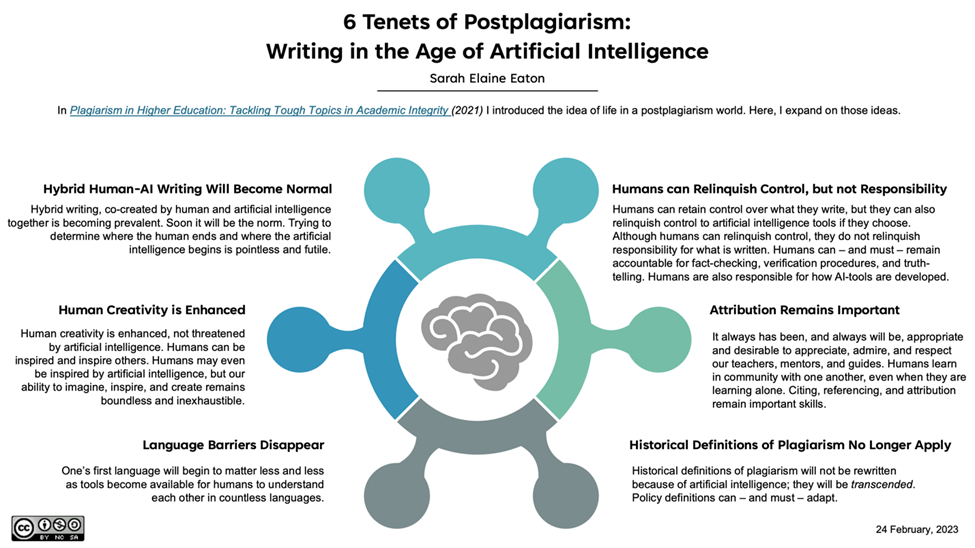
Human-AI Collaboration is the New Norm
One major aspect of postplagiarism recognizes that hybrid human-AI writing is increasingly common and will soon be an expected part of digital content creation. Perplexity’s AI-driven summaries exemplify this, with AI performing initial tasks while users and organizations curate, refine, and contextualize the output. As postplagiarism suggests, trying to delineate where the AI’s contribution ends and human input begins is futile; the end product is a blend, where AI enables, but humans oversee, the information presented.
Human can Relinquish Control but not Responsibility
While AI can handle much of the process, postplagiarism emphasizes that human responsibility remains central. Although Perplexity claims to summarize accurately and cite its sources, responsibility for the final output’s integrity ultimately rests with its creators. This aligns with postplagiarism’s stance that humans, despite entrusting tasks to AI, cannot abdicate accountability for the content, including ensuring its ethical and factual accuracy.
Attribution Remains Important
The emphasis on citation by Perplexity’s CEO underscores a core postplagiarism tenet: attribution is critical in upholding ethical standards. However, meeting the standard for robust attribution in AI contexts is complex. Perplexity’s case illustrates this struggle, as traditional citation may fail to capture the nuances of AI’s interaction with source material. Postplagiarism advocates for adapted approaches to attribution that recognize AI’s role while acknowledging original content creators.
Reconsidering Plagiarism Definitions in the Age of AI
The crux of the legal debate surrounding Perplexity involves whether its AI-generated summaries constitute plagiarism. According to postplagiarism, historical definitions of plagiarism may no longer apply to AI contexts, where summarizing and synthesizing content are not as clear-cut as in human-only creation. Perplexity’s case emphasizes the need for evolving policies and definitions in academic and media sectors to accommodate AI-driven content, where both human oversight and technological contribution play vital roles.
In examining Perplexity’s practices through postplagiarism, we underscore the need to expand our understanding of plagiarism and originality as digital tools reshape content creation. The postplagiarism framework is not merely a critique of AI-driven platforms but an invitation to re-envision authorship, responsibility, and ethical standards in an era increasingly defined by human-AI collaboration.
Why Postplagiarism Matters in the Age of AI Content Creation
The postplagiarism framework reorients the debate on plagiarism beyond simply detecting content duplication to understanding how AI reshapes responsibility, originality, and ethics in content creation. In cases like Perplexity’s, this perspective is crucial because it recognizes that AI is no longer a mere tool but a collaborator whose outputs, if mishandled, could erode public trust in information sources.
AI-driven platforms like Perplexity are already reshaping education, journalism, and personal information consumption. Without a framework that clarifies who holds ethical accountability, audiences risk consuming information detached from its original source, possibly diluted in meaning or quality. Postplagiarism, therefore, is not just a concept; it is a call to update our practices, policies, and ethical standards to address these shifts, ensuring that attribution and responsibility remain transparent and meaningful.
By embracing postplagiarism, we respond to AI’s challenges not by clinging to outdated definitions of plagiarism but by equipping educators, journalists, and content creators with a practical model for navigating the responsibilities of AI-human co-creation. This shift is essential for maintaining integrity and trust in digital content, particularly as AI becomes more integrated into everyday information processing.
Conclusion
The postplagiarism framework offers a timely and necessary shift in how we address plagiarism in the era of AI-driven content creation. As AI tools like Perplexity blur the lines between summarizing, synthesizing, and creating, traditional definitions of plagiarism and attribution fall short, leaving both creators and consumers in a gray area. Postplagiarism reframes this issue by emphasizing accountability, adaptation, and ethical responsibility in hybrid human-AI creation. As we move forward, this approach enables us to uphold academic and journalistic integrity, fostering a digital landscape where responsibility and respect for original work remain central, even in the age of AI.
Share this post: The Role of Postplagiarism in Understanding AI-Generated Content. https://postplagiarism.com/2024/11/15/the-role-of-postplagiarism-in-understanding-ai-generated-content/
About the author: Rahul Kumar, PhD, is Assistant Professor in the Department of Educational Studies, Brock University.
 Postplagiarism
Leave a comment